

[2022] Easy To Download L4M5 Actual Exam Dumps Resources
Uplift Your L4M5 Exam Marks With The Help of L4M5 Dumps
NEW QUESTION 21
An experienced procurement professional is developing strategies for forthcoming negotiations with her key supplier. To avoid negotiation deadlocks, she identifies the reasons whynegotiations could fail. Which of the following are most likely to be reasons for negotiation failures? Select TWO that apply.
- A. Underlying interests of TOP are overlooked
- B. MIL objectives are well established
- C. Buyer helps to create a co-operative atmosphere
- D. Both parties focus on common interests
- E. Unachievable objectives were set up
Answer: A,E
Explanation:
It has been said that most negotiations are won (or lost) at the preparation stage. Success in a negotiation cannot be claimed unless you can refer back to your objectives and show how you have achieve them. In broad terms, negotiation plans/strategies involve 4 key activities:
1. Developing and prioritising your objectives and limits
2. Seeking to understand TOP's objectives
3. Developing concession plans
4. Planning the resources and logistics required and agreeing team roles.
Questions to gain an understanding of why a negotiation failed
Did we collect and make effective use of all information available when preparing for the negotiation?
Did we set objectives for the negotiation that were stretching and achievable and established MIL objectives?
Did we determine a strategy for the negotiation?
Did the other party understand our needs correctly?
Were we aware of the underlying interests of the other party?
Were our proposals convincing enough for acceptance by the other party?
Did we explore different variables in the negotiation?
Did we fully understand all proposals?
Did we give any unplanned concessions and did we check the importance of these?
Did we focus on common interests?
Did we ask a range of questions?
Did we get answers to all our questions?
Could we answer all the questions addressed to us in a proper and positive way?
Did we summarise effectively?
Did we use different methods of persuasion in the negotiations?
Which tactics did we use and what effect did they have?
Did our negotiating team work well as a team?
Did we help to create a co-operative atmosphere
NEW QUESTION 22
If a negotiation results in an offer which does not meet the buyer's minimum requirements, which of the following could the buyer pursue?
- A. ZOPA
- B. BATNA
- C. PESTLE
- D. STEEPLE
Answer: B
Explanation:
Explanation
Best alternative to a negotiatedagreement (BATNA) is the plan B or back-up plan in the event of a 'walk away'. In case of no deal, buyer (or supplier) may switch to this option.
The zone of potential agreement (ZOPA) is considered an area where two or more negotiating parties may find common ground. It is this area where parties will often compromise and strike a deal. In order for negotiating parties to find a settlement or reach an agreement, they must work towards a common goal and seek an area that incorporates at least some of each party's ideas.
STEEPLE offers an overview of various external fields. It is an acronym for Social, Technological, Economic, Environmental, Political, Legal and Ethical.
PESTLE is a mnemonic which in its expanded form denotes P for Political, E for Economic,S for Social, T for Technological, L for Legal and E for Environmental. It gives a bird's eye view of the whole environment from many different angles that one wants to check and keep a track of while contemplating on a certain idea/plan.
LO 1, AC 1.2
NEW QUESTION 23
In which of the following costing methods, overhead costs are applied in proportion to production volume?
- A. Marginal costing
- B. Absorption costing
- C. Mark-up costing
- D. Activity-based costing
Answer: B
Explanation:
There are 3 major costing methods:
Marginal costing
* Uses marginal cost of producing addition units
* Uses variable cost to derived a unit cost (does not include fixed cost)
* Fixed cost treated as a 'period cost' and deducted, as a total amount, from total contribution to profit for the period, in the firm's profit and loss account Absorption costing
* Calculates total cost of producing product
* In addition to variable cost, a fair proportion of fixed cost is allocated to (absorbed) eachunit of output, as a fixed cost per unit Activity based costing
* Similar to absorption costing but with fixed cost allocated to products on the basis of the cost of activities used in producing them LO 2, AC 2.1
NEW QUESTION 24
Which of the following would cause a demand curve for a good to be price inelastic?
- A. The necessary goods
- B. The consultancy service
- C. There are a great number of substitutes for the good
- D. The luxury goods
Answer: A
Explanation:
Explanation
Essential goods andservices such as electricity, fuel, basic food stuffs, commuter transport and habitual products such as tobacco, alcohol and sugar-based drinks are often sited as facing a relatively inelastic demand curve. This means when the price goes up, the quantity demanded does not decrease very much and so they are often the target of government taxation.
LO2, AC 2.2
NEW QUESTION 25
Which of the following is the best description of direct cost?
- A. Direct costs include raw materials, labour andoverheads
- B. Direct costs are only variable raw materials that constitute a product
- C. Direct costs include raw materials, labour and other expenses attributable to the final product
- D. Direct costs include only raw materials and labour of making the final product
Answer: C
Explanation:
Direct costs are those costs of a product/service directly attributable/traceable to its production, for example, the costs of labour and materials directly used to produce the goods/services which the organisation sells.
NEW QUESTION 26
Understanding supplier's mark-up and margin can provide procurement professional a comprehensive insight into supplier's net profits. Is this statement true?
- A. Yes,because these are two indicators of supplier's future prospect
- B. No, because margin is enough to tell procurement about supplier's profitability
- C. Yes, becausesupplier's mark-up and margin are two most valuable sources of information to procurement
- D. No, because mark-up and margin inform little about supplier's net profit
Answer: D
Explanation:
Explanation
Mark-up and margin allow supplier to make gross profit. Remember that every supplier operates under different cost structures and some are set up to be most profitableat a particular level of volume, so it is dangerous to assume all suppliers can survive on a lower margin if their volume increases. Intelligent buyers understand that mark-up and margin may define gross profits, but they tell you very little about a supplier's net profits.
LO 2, AC 2.1
NEW QUESTION 27
In general, which of the following is the consequence of a flatter demand curve?
- A. Quantityelastic
- B. Unit price elastic
- C. Price inelastic
- D. Price elastic
Answer: D
Explanation:
Explanation
Elasticity refers to the responsiveness of quantity demanded or quantity supplied to a change in price or another factor.
In microeconomic graphs,elasticity and inelasticity can be shown by the slope of the demand curve. If a demand curve is almost horizontal, then the product pricing can be described as very elastic. If a demand curve is almost vertical, then the product pricing can be described asvery inelastic.
The formulae of elasticity:
Text Description automatically generated with low confidence
Table Description automatically generated with medium confidence
Table Description automatically generated with low confidence
LO 2, AC 2.2
NEW QUESTION 28
At which stage in a negotiation would questions be asked to obtain missing information?
- A. The opening stage
- B. The proposing stage
- C. The testing stage
- D. The bargaining stage
Answer: C
Explanation:
There are 5 key phases of negotiation:
The opening phase: confirm understanding and get the issue on the table The testing phase: check assumption and confirm understanding The proposing phase:asking 'if' The bargaining phase: using tradeables The agreement and closing phase The testing could take the form of questions following a presentation by either side or questions on a tender or proposal document received by the buyer from the potential supplier. The testing phase is necessary to confirm that your approach and objectives are appropriate for the negotiation situation you now find yourself in.
Careful listening, observation and interpretation of TOP's responses may give indication of the following:
Areas where TOP is willing and unwilling to make concessions
What factors or issues TOP places a high value on
If there are any non-commercial or emotional factors that may be pertinent TOP's underlying interests - why they are taking the positionthey are.
NEW QUESTION 29
Which of the following are most likely to harm trust between buyer and supplier in a commercial relationship?
Select TWO that apply.
- A. Exploring a disagreement to learn from each other's insights
- B. Avoidance of submitting important documentations
- C. Resolving some conditions that would otherwise have them competing for resources
- D. Reduced response time during contract performance
- E. Subjective assessment of performance
Answer: B,E
Explanation:
Explanation
Trust-destroying behaviours:
- Rumours of partnership or relationship breaking down
- Emotion-based assessment of performance
- Avoiding accountability, passing the blame to others
- General mood - resentment, distrust,frustration, etc
LO 1, AC 1.4
NEW QUESTION 30
According to Professor Gavin Kennedy, in which of the following forms of dispute resolution, both parties will voluntarily exchange their ideas and beliefs?
- A. Gambling
- B. Persuasion
- C. Litigation
- D. Negotiation
Answer: D
Explanation:
Professor Gavin Kennedy highlights that we need to distinguish negotiation from other forms of decision-making by focusing on what is unique about it (the voluntary exchange) and not shared by other techniques such as persuasion, gambling (e.g., coin tossing), command decision, instruction, litigation and coercion.
NEW QUESTION 31
Which type of question should be used to receive affirmation on statement?
- A. Open
- B. Narrow
- C. Closed
- D. Leading
Answer: C
Explanation:
Different questioning styles can be used to elicit desired responses:
Text Description automatically generated
NEW QUESTION 32
Which of the following are most likely to be the potential cultural differences that can make transactions with an international supplier more problematic that with local suppliers? Select TWO that apply.
- A. Payment mechanism
- B. Incoterms and logistics difficulties
- C. The use and interpretation of body language
- D. Currency exchange fluctuation
- E. The importance of timescales
Answer: C,E
Explanation:
Explanation
The question requires student to detect factors of cultural differences. Problems may occur on the international scene with such things as the importance of extending courtesy between cultures, the importance of timescales, the use of negotiating ploys, the sense of 'fair play', the use and interpretation of body language, the role of women in negotiations (or indeed, in business in general), the importance of status, the role of conflict, standards of dress and deportment and the readiness to ignore or uphold contract terms and conditions.
LO 3, AC 3.3
NEW QUESTION 33
Telephone is most likely to be used for which of the following negotiations?
- A. Complex one-off purchase
- B. Contract for purchasing a specialised product
- C. High value contract
- D. Routinetransactions
Answer: D
Explanation:
Explanation
Many commercial negotiations could be considered routine or just not worth the investment for buyers, and using the phone can make more sense and can be more immediate.
LO 2, AC 2.4
NEW QUESTION 34
If the price of a good is above the equilibrium price, which of the following will happen?
- A. There is a surplus (i.e. an excess supply) and the price will rise
- B. The quantity demanded is equal to the quantity supplied and the price remains unchanged
- C. There is a surplus (i.e. an excess supply) and the price will fall
- D. There is a shortage (i.e. an excess demand) and the price will fall
Answer: C
Explanation:
In microeconomics, equilibrium price is determined when the quantity demanded is equal to thequantity supplied at equilibrium price in a market, there will be no shortages and no surpluses. If we combine our supply and demand curves on one graph, the point at which they converge determines the equilibrium price. If the price is set above this price and you read across the graph you will see the supply excess demand and there will be a surplus. In order to reduce this surplus, the price will need to fall. The scenario is illustrated in the graph below:
Chart, line chart Description automatically generated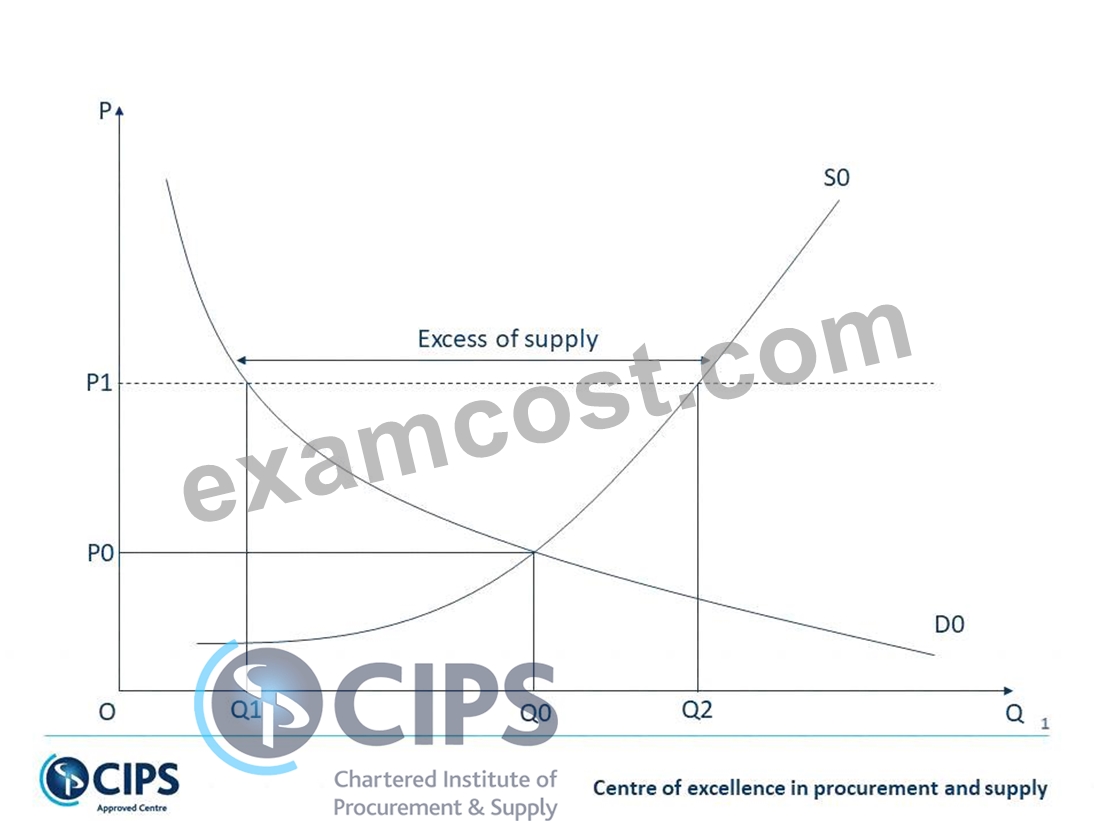
NEW QUESTION 35
Distributive approach in negotiation is typified by which of the following?
- A. Both parties share 50:50 of the 'pie'
- B. Both parties understand each other's goals
- C. Each party attempts to maximise the value obtained at other's expense
- D. Distributive approaches are inherently inferior tointegrative approaches in commercial negotiation
Answer: C
Explanation:
Distributive approach to negotiation used when the interested parties are attempting to divide something up or distribute something of value, also known as zero-sum approach or win-lose. Commercial situations often demand a distributive bargaining approach, if the 'pie' is inherently of a fixed size. In this case, any conflicts must be resolved by sharing it.
In win-lose approach, a negotiator wants to maximise the value obtained in a single deal, the relationship with the other party is not important. Therefore, a strong party may win more than 50% of the metaphorical 'pie'.
It should not be assumed that win-win can be applied to all commercial negotiations, or that win-lose approaches are inherently inferior.
NEW QUESTION 36
When is the best time in procurement process in which procurement should get involved so that the cost-saving opportunities are the greatest?
- A. Market consult stage
- B. Post-tender stage
- C. Specification stage
- D. Post-contract stage
Answer: C
Explanation:
Explanation
The earlier procurement get involved in the procurement processes, the better. If procurement are involved in design at the specification stage they can feed in prices and costs to designer so they know the likely budget implication of choices made. Sending in a procurement team to negotiate at or close to the end ofthe procurement process effectively ties their hands and limits their negotiation leverage. This is illustrated in the graph below:
Chart Description automatically generated
LO 2, AC 2.1
NEW QUESTION 37
Which of the following is the area where two or more negotiating parties may find common ground?
- A. Zone of proximal development
- B. Zone of potential agreement
- C. Walk away area
- D. Best alternative to a negotiated agreement
Answer: B
Explanation:
Explanation
The zone of possible agreement (ZOPA) orbargaining range is considered an area where two or more negotiating parties may find common ground. It is this area where parties will often compromise and strike a deal. In order for negotiating parties to find a settlement or reach an agreement, they must work towards a common goal and seek an area that incorporates at least some of each party's ideas.
The zone of proximal development refers to the difference between what a learner can do without help and what he or she can achieve with guidance and encouragement from a skilled partner.
There is no Walk away area. Walk away point is a position from which you cannot concede any more ground and must walk away/decline a deal.
Best alternative to a negotiated agreement is a fallback or backstop position if the negotiation fails to result in an agreement/no deal is agreed.
LO 1, AC 1.2
NEW QUESTION 38
Which of the following is a disadvantage of absorption costing method?
- A. Limited understanding of true costs incurred
- B. Fixedcost allocated to products on the basis of the cost of activities used in producing them
- C. Using marginal cost of producing addition units
- D. Variable costs are not taken into product final costs
Answer: A
Explanation:
Absorption costing is an approach to allocating overheads in which indirect costs are loaded or absorbed into direct costs related to specific jobs, processes or outputs, using an estimated basis of allocation.
Graphical user interface, text, chat or text message, website Description automatically generated
NEW QUESTION 39
An automotive company purchases high quality steel to produce components. The steel is an important raw material and the contract value is enormous. They sources the steel from oversea and contact some potential suppliers. One of the potential suppliers invites the procurement team to their premise for a new business opportunity. Should the procurement team accept the invitation?
- A. No, because the travel would incur unnecessary costs
- B. No, because negotiating over telephone is enough to collect information on supplier's capability
- C. Yes, because this is an opportunity to assess the supplier's capacity
- D. Yes, because the visit would increase the buyer's bargaining power
Answer: C
Explanation:
Explanation
In the scenario, the value of contract as well as the importance of purchased item justify the procurement's travel. Visiting a supplier at their HQ or operational facility may facilitate the procurement team in assessing, albeit briefly, the culture of the organisation, how busy they seem and how staff engage with each other. A visit is a good opportunity to assess supplier's capacity.
LO 2, AC 2.2
NEW QUESTION 40
A procurement professional is preparing for a negotiation of purchasing non-critical commodity products. He knows that the product can be easily replaced by other substitutes in the market. The negotiation for these products is typified by which of the following?
- A. There will be only limited negotiation
- B. There will be regular structured negotiations
- C. The buyer should focus on wider costs and risk elements
- D. The approach must be collaborative
Answer: A
Explanation:
Explanation
With non-critical commodity products, the relationship will be transactional. Buyer should not spend too much time and effort into the negotiation.
Table Description automatically generated
LO 1, AC 1.4
NEW QUESTION 41
The buyer's bargaining power tends to berelatively higher than supplier's bargaining power in which of the following circumstances?
- A. The buyer demand isso urgent that it can't be postponed
- B. The buyer does not have the option to move to an alternative supplier
- C. The buyer is large in size relative to its suppliers
- D. The buyer's spend takes up a small proportion of supplier revenue
Answer: C
Explanation:
Buyer power gives customers/consumers (buyers) the ability to squeeze industry margins by pressuring firms (the suppliers) to reduce prices or increase the quality of services or products offered.
There are four major factors to consider when determining the bargaining power of buyers:
1. Number of buyers relative to suppliers: If the number of buyers is small relative to that of suppliers,the buyer's power will be stronger.
2. Dependence of a buyer's purchase on a particular supplier: If a buyer is able to get similar products/services from other suppliers, buyers depend less on a particular supplier. Therefore, the power of the buyer would be greater.
3. Switching costs: If there are not many alternative suppliers available, the cost of switching is high.
Therefore, buyer power would be low.
4. Backward Integration: If the buyer is able to integrate or merge suppliers, the buyer has greater bargaining power over the existing suppliers.
When is Bargaining Power of Buyers High/Strong?
There are fewer buyers relative to that of suppliers
The switching costs of the buyer are low
If the buyer is able to backward integrate
The buyer purchases product in bulk (high volume)
The buyer is able to get similar product/services from other suppliers
The buyer purchases the majority of the seller's products
Several substitutes are available on the market
Product is not differentiated
NEW QUESTION 42
......
CIPS L4M5 Exam Syllabus Topics:
| Topic | Details |
|---|---|
| Topic 1 |
|
| Topic 2 |
|
| Topic 3 |
|
| Topic 4 |
|
| Topic 5 |
|
| Topic 6 |
|
| Topic 7 |
|
| Topic 8 |
|
| Topic 9 |
|
| Topic 10 |
|
| Topic 11 |
|
Use CIPS L4M5 Dumps To Succeed Instantly in L4M5 Exam: https://pass4sure.examcost.com/L4M5-practice-exam.html
