

[Nov-2023] Latest Professional-Machine-Learning-Engineer Exam Dumps for Pass Guaranteed
Reliable Google Cloud Certified Professional-Machine-Learning-Engineer Dumps PDF Nov 21, 2023 Recently Updated Questions
Google Professional-Machine-Learning-Engineer (Google Professional Machine Learning Engineer) Certification Exam is a professional-level certification exam offered by Google that tests your proficiency in building and deploying machine learning models on Google Cloud Platform. Professional-Machine-Learning-Engineer exam is designed for individuals who have a solid understanding of machine learning concepts and have experience in building and deploying machine learning models on Google Cloud Platform.
Google Professional Machine Learning Engineer Certification Exam is an essential credential for professionals seeking to advance their careers in machine learning. It provides a comprehensive assessment of a candidate's knowledge and skills in designing and implementing machine learning models and systems on the Google Cloud Platform. With the demand for machine learning professionals on the rise, obtaining this certification can open up new opportunities for career growth and advancement.
Google Professional Machine Learning Engineer exam is an excellent way for experienced machine learning professionals to demonstrate their expertise in this field and to enhance their career prospects. Whether you are looking to advance your career or to simply stay up-to-date with the latest trends and technologies in machine learning, this certification program is a valuable investment in your professional development.
NEW QUESTION # 76
A retail chain has been ingesting purchasing records from its network of 20,000 stores to Amazon S3 using Amazon Kinesis Data Firehose. To support training an improved machine learning model, training records will require new but simple transformations, and some attributes will be combined. The model needs to be retrained daily.
Given the large number of stores and the legacy data ingestion, which change will require the LEAST amount of development effort?
- A. Insert an Amazon Kinesis Data Analytics stream downstream of the Kinesis Data Firehose stream that transforms raw record attributes into simple transformed values using SQL.
- B. Deploy an Amazon EMR cluster running Apache Spark with the transformation logic, and have the cluster run each day on the accumulating records in Amazon S3, outputting new/transformed records to Amazon S3.
- C. Require that the stores to switch to capturing their data locally on AWS Storage Gateway for loading into Amazon S3, then use AWS Glue to do the transformation.
- D. Spin up a fleet of Amazon EC2 instances with the transformation logic, have them transform the data records accumulating on Amazon S3, and output the transformed records to Amazon S3.
Answer: A
NEW QUESTION # 77
You trained a text classification model. You have the following SignatureDefs:
What is the correct way to write the predict request?
- A. data = json dumps({"signature_name": "serving_default"! "instances": [['a', 'b', "c", 'd', 'e', 'f']]})
- B. data = json.dumps({"signature_name": "serving_default, "instances": [['a', 'b\ 'c'1, [d\ 'e\ T]]})
- C. data = json dumps({"signature_name": f,serving_default", "instances": [['a', 'b'], [c\ 'd'], ['e\ T]]})
- D. data = json.dumps({"signature_name": "serving_default'\ "instances": [fab', 'be1, 'cd']]})
Answer: A
NEW QUESTION # 78
You are a data scientist at an industrial equipment manufacturing company. You are developing a regression model to estimate the power consumption in the company's manufacturing plants based on sensor data collected from all of the plants. The sensors collect tens of millions of records every day. You need to schedule daily training runs for your model that use all the data collected up to the current date. You want your model to scale smoothly and require minimal development work. What should you do?
- A. Develop a regression model using BigQuery ML.
- B. Develop a custom TensorFlow regression model, and optimize it using Vertex Al Training.
- C. Develop a custom PyTorch regression model, and optimize it using Vertex Al Training
- D. Develop a custom scikit-learn regression model, and optimize it using Vertex Al Training
Answer: A
Explanation:
BigQuery ML is a powerful tool that allows you to build and deploy machine learning models directly within BigQuery, Google's fully-managed, serverless data warehouse. It allows you to create regression models using SQL, which is a familiar and easy-to-use language for many data scientists. It also allows you to scale smoothly and require minimal development work since you don't have to worry about cluster management and it's fully-managed by Google.
BigQuery ML also allows you to run your training on the same data where it's stored, this will minimize data movement, and thus minimize cost and time.
Reference:
BigQuery ML
BigQuery ML for regression
BigQuery ML for scalability
NEW QUESTION # 79
This graph shows the training and validation loss against the epochs for a neural network.
The network being trained is as follows:
* Two dense layers, one output neuron
* 100 neurons in each layer
* 100 epochs
* Random initialization of weights
Which technique can be used to improve model performance in terms of accuracy in the validation set?
- A. Random initialization of weights with appropriate seed
- B. Adding another layer with the 100 neurons
- C. Early stopping
- D. Increasing the number of epochs
Answer: D
NEW QUESTION # 80
You are training an LSTM-based model on Al Platform to summarize text using the following job submission script: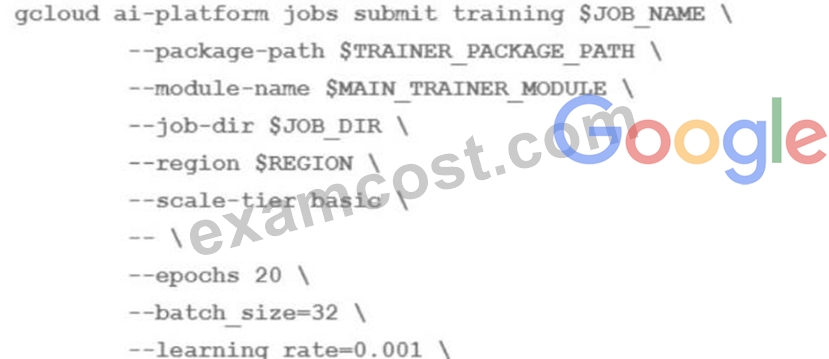
You want to ensure that training time is minimized without significantly compromising the accuracy of your model. What should you do?
- A. Modify the 'learning rate' parameter
- B. Modify the 'scale-tier' parameter
- C. Modify the batch size' parameter
- D. Modify the 'epochs' parameter
Answer: C
NEW QUESTION # 81
A Machine Learning Specialist is using an Amazon SageMaker notebook instance in a private subnet of a corporate VPC. The ML Specialist has important data stored on the Amazon SageMaker notebook instance's Amazon EBS volume, and needs to take a snapshot of that EBS volume. However, the ML Specialist cannot find the Amazon SageMaker notebook instance's EBS volume or Amazon EC2 instance within the VPC.
Why is the ML Specialist not seeing the instance visible in the VPC?
- A. Amazon SageMaker notebook instances are based on the EC2 instances within the customer account, but they run outside of VPCs.
- B. Amazon SageMaker notebook instances are based on the Amazon ECS service within customer accounts.
- C. Amazon SageMaker notebook instances are based on EC2 instances running within AWS service accounts.
- D. Amazon SageMaker notebook instances are based on AWS ECS instances running within AWS service accounts.
Answer: C
Explanation:
Explanation/Reference: https://docs.aws.amazon.com/sagemaker/latest/dg/gs-setup-working-env.html
NEW QUESTION # 82
A Machine Learning Specialist is preparing data for training on Amazon SageMaker. The Specialist is using one of the SageMaker built-in algorithms for the training. The dataset is stored in .CSV format and is transformed into a numpy.array, which appears to be negatively affecting the speed of the training.
What should the Specialist do to optimize the data for training on SageMaker?
- A. Transform the dataset into the RecordIO protobufformat.
- B. Use the SageMaker hyperparameter optimization feature to automatically optimize the data.
- C. Use the SageMaker batch transform feature to transform the training data into a DataFrame.
- D. Use AWS Glue to compress the data into the Apache Parquet format.
Answer: A
NEW QUESTION # 83
You are an ML engineer in the contact center of a large enterprise. You need to build a sentiment analysis tool that predicts customer sentiment from recorded phone conversations. You need to identify the best approach to building a model while ensuring that the gender, age, and cultural differences of the customers who called the contact center do not impact any stage of the model development pipeline and results. What should you do?
- A. Convert the speech to text and extract sentiments based on the sentences
- B. Convert the speech to text and extract sentiment using syntactical analysis
- C. Extract sentiment directly from the voice recordings
- D. Convert the speech to text and build a model based on the words
Answer: B
Explanation:
To ensure that gender, age, and cultural differences of the customers who called the contact center do not impact any stage of the model development pipeline and results, it is important to focus on the meaning and context of the conversation, rather than the characteristics of the speaker.
Converting the speech to text and then using syntactical analysis to extract sentiment will allow you to focus on the meaning and context of the conversation, rather than characteristics of the speaker. This approach will also give you more data to work with, as you can analyze the entire conversation, rather than just the voice recordings.
NEW QUESTION # 84
You are developing a Kubeflow pipeline on Google Kubernetes Engine. The first step in the pipeline is to issue a query against BigQuery. You plan to use the results of that query as the input to the next step in your pipeline. You want to achieve this in the easiest way possible. What should you do?
- A. Write a Python script that uses the BigQuery API to execute queries against BigQuery Execute this script as the first step in your Kubeflow pipeline
- B. Locate the Kubeflow Pipelines repository on GitHub Find the BigQuery Query Component, copy that component's URL, and use it to load the component into your pipeline. Use the component to execute queries against BigQuery
- C. Use the BigQuery console to execute your query and then save the query results Into a new BigQuery table.
- D. Use the Kubeflow Pipelines domain-specific language to create a custom component that uses the Python BigQuery client library to execute queries
Answer: B
Explanation:
https://linuxtut.com/en/f4771efee37658c083cc/
https://github.com/kubeflow/pipelines/blob/master/components/gcp/bigquery/query/sample.ipynb
; https://v0-5.kubeflow.org/docs/pipelines/reusable-components/
NEW QUESTION # 85
You have trained a deep neural network model on Google Cloud. The model has low loss on the training data, but is performing worse on the validation dat a. You want the model to be resilient to overfitting. Which strategy should you use when retraining the model?
- A. Apply a dropout parameter of 0 2, and decrease the learning rate by a factor of 10
- B. Apply a 12 regularization parameter of 0.4, and decrease the learning rate by a factor of 10.
- C. Run a hyperparameter tuning job on Al Platform to optimize for the L2 regularization and dropout parameters
- D. Run a hyperparameter tuning job on Al Platform to optimize for the learning rate, and increase the number of neurons by a factor of 2.
Answer: D
NEW QUESTION # 86
Your team trained and tested a DNN regression model with good results. Six months after deployment, the model is performing poorly due to a change in the distribution of the input dat a. How should you address the input differences in production?
- A. Retrain the model, and select an L2 regularization parameter with a hyperparameter tuning service
- B. Create alerts to monitor for skew, and retrain the model.
- C. Perform feature selection on the model, and retrain the model on a monthly basis with fewer features
- D. Perform feature selection on the model, and retrain the model with fewer features
Answer: B
Explanation:
Data drift doesn't necessarily require feature reselection (e.g. by L2 regularization). https://cloud.google.com/architecture/mlops-continuous-delivery-and-automation-pipelines-in-machine-learning#challenges Data values skews: These skews are significant changes in the statistical properties of data, which means that data patterns are changing, and you need to trigger a retraining of the model to capture these changes. https://developers.google.com/machine-learning/guides/rules-of-ml/#rule_37_measure_trainingserving_skew
NEW QUESTION # 87
You are an ML engineer at a large grocery retailer with stores in multiple regions. You have been asked to create an inventory prediction model. Your models features include region, location, historical demand, and seasonal popularity. You want the algorithm to learn from new inventory data on a daily basis. Which algorithms should you use to build the model?
- A. Classification
- B. Reinforcement Learning
- C. Convolutional Neural Networks (CNN)
- D. Recurrent Neural Networks (RNN)
Answer: D
Explanation:
"algorithm to learn from new inventory data on a daily basis" = time series model , best option to deal with time series is forsure RNN
https://builtin.com/data-science/recurrent-neural-networks-and-lstm
NEW QUESTION # 88
You trained a text classification model. You have the following SignatureDefs:
What is the correct way to write the predict request?
- A. data = json.dumps({"signature_name": "serving_default, "instances": [['a', 'b\ 'c'1, [d\ 'e\ T]]})
- B. data = json dumps({"signature_name": f,serving_default", "instances": [['a', 'b'], [c\ 'd'], ['e\ T]]})
- C. data = json dumps({"signature_name": "serving_default"! "instances": [['a', 'b', "c", 'd', 'e', 'f']]})
- D. data = json.dumps({"signature_name": "serving_default'\ "instances": [fab', 'be1, 'cd']]})
Answer: A
NEW QUESTION # 89
A city wants to monitor its air quality to address the consequences of air pollution. A Machine Learning Specialist needs to forecast the air quality in parts per million of contaminates for the next 2 days in the city. As this is a prototype, only daily data from the last year is available.
Which model is MOST likely to provide the best results in Amazon SageMaker?
- A. Use the Amazon SageMaker Linear Learner algorithm on the single time series consisting of the full year of data with a predictor_typeof regressor.
- B. Use the Amazon SageMaker Linear Learner algorithm on the single time series consisting of the full year of data with a predictor_typeof classifier.
- C. Use the Amazon SageMaker k-Nearest-Neighbors (kNN) algorithm on the single time series consisting of the full year of data with a predictor_typeof regressor.
- D. Use Amazon SageMaker Random Cut Forest (RCF) on the single time series consisting of the full year of data.
Answer: A
Explanation:
Explanation/Reference: https://aws.amazon.com/blogs/machine-learning/build-a-model-to-predict-the-impact-of-weather- on-urban-air-quality-using-amazon-sagemaker/?ref=Welcome.AI
NEW QUESTION # 90
You are training an ML model using data stored in BigQuery that contains several values that are considered Personally Identifiable Information (Pll). You need to reduce the sensitivity of the dataset before training your model. Every column is critical to your model. How should you proceed?
- A. Use the Cloud Data Loss Prevention (DLP) API to scan for sensitive data, and use Dataflow with the DLP API to encrypt sensitive values with Format Preserving Encryption
- B. Use the Cloud Data Loss Prevention (DLP) API to scan for sensitive data, and use Dataflow to replace all sensitive data by using the encryption algorithm AES-256 with a salt.
- C. Using Dataflow, ingest the columns with sensitive data from BigQuery, and then randomize the values in each sensitive column.
- D. Before training, use BigQuery to select only the columns that do not contain sensitive data Create an authorized view of the data so that sensitive values cannot be accessed by unauthorized individuals.
Answer: D
Explanation:
This approach would allow you to keep the critical columns of data while reducing the sensitivity of the dataset by removing the personally identifiable information (PII) before training the model. By creating an authorized view of the data, you can ensure that sensitive values cannot be accessed by unauthorized individuals.
NEW QUESTION # 91
You are training an object detection model using a Cloud TPU v2. Training time is taking longer than expected. Based on this simplified trace obtained with a Cloud TPU profile, what action should you take to decrease training time in a cost-efficient way?
- A. Rewrite your input function to resize and reshape the input images.
- B. Move from Cloud TPU v2 to Cloud TPU v3 and increase batch size.
- C. Rewrite your input function using parallel reads, parallel processing, and prefetch.
- D. Move from Cloud TPU v2 to 8 NVIDIA V100 GPUs and increase batch size.
Answer: B
NEW QUESTION # 92
Your team is building a convolutional neural network (CNN)-based architecture from scratch. The preliminary experiments running on your on-premises CPU-only infrastructure were encouraging, but have slow convergence. You have been asked to speed up model training to reduce time-to-market. You want to experiment with virtual machines (VMs) on Google Cloud to leverage more powerful hardware. Your code does not include any manual device placement and has not been wrapped in Estimator model-level abstraction. Which environment should you train your model on?
- A. A Deep Learning VM with an n1-standard-2 machine and 1 GPU with all libraries pre-installed.
- B. AVM on Compute Engine and 8 GPUs with all dependencies installed manually.
- C. AVM on Compute Engine and 1 TPU with all dependencies installed manually.
- D. A Deep Learning VM with more powerful CPU e2-highcpu-16 machines with all libraries pre-installed.
Answer: A
Explanation:
https://cloud.google.com/deep-learning-vm/docs/cli#creating_an_instance_with_one_or_more_gpus
https://cloud.google.com/deep-learning-vm/docs/introduction#pre-installed_packages
"speed up model training" will make us biased towards GPU,TPU options by options eliminations we may need to stay away of any manual installations , so using preconfigered deep learning will speed up time to market
NEW QUESTION # 93
You are working on a binary classification ML algorithm that detects whether an image of a classified scanned document contains a company's logo. In the dataset, 96% of examples don't have the logo, so the dataset is very skewed. Which metrics would give you the most confidence in your model?
- A. F-score where recall is weighed more than precision
- B. RMSE
- C. F1 score
- D. F-score where precision is weighed more than recall
Answer: A
NEW QUESTION # 94
A Data Scientist needs to migrate an existing on-premises ETL process to the cloud. The current process runs at regular time intervals and uses PySpark to combine and format multiple large data sources into a single consolidated output for downstream processing.
The Data Scientist has been given the following requirements to the cloud solution:
* Combine multiple data sources.
* Reuse existing PySpark logic.
* Run the solution on the existing schedule.
* Minimize the number of servers that will need to be managed.
Which architecture should the Data Scientist use to build this solution?
- A. Use Amazon Kinesis Data Analytics to stream the input data and perform real-time SQL queries against the stream to carry out the required transformations within the stream. Deliver the output results to a
"processed" location in Amazon S3 that is accessible for downstream use. - B. Write the raw data to Amazon S3. Schedule an AWS Lambda function to run on the existing schedule and process the input data from Amazon S3. Write the Lambda logic in Python and implement the existing PySpark logic to perform the ETL process. Have the Lambda function output the results to a "processed" location in Amazon S3 that is accessible for downstream use.
- C. Write the raw data to Amazon S3. Schedule an AWS Lambda function to submit a Spark step to a persistent Amazon EMR cluster based on the existing schedule. Use the existing PySpark logic to run the ETL job on the EMR cluster. Output the results to a "processed" location in Amazon S3 that is accessible for downstream use.
- D. Write the raw data to Amazon S3. Create an AWS Glue ETL job to perform the ETL processing against the input data. Write the ETL job in PySpark to leverage the existing logic. Create a new AWS Glue trigger to trigger the ETL job based on the existing schedule. Configure the output target of the ETL job to write to a
"processed" location in Amazon S3 that is accessible for downstream use.
Answer: A
Explanation:
Explanation
NEW QUESTION # 95
Your team needs to build a model that predicts whether images contain a driver's license, passport, or credit card. The data engineering team already built the pipeline and generated a dataset composed of 10,000 images with driver's licenses, 1,000 images with passports, and 1,000 images with credit cards. You now have to train a model with the following label map: ['driversjicense', 'passport', 'credit_card']. Which loss function should you use?
- A. Binary cross-entropy
- B. Sparse categorical cross-entropy
- C. Categorical hinge
- D. Categorical cross-entropy
Answer: B
Explanation:
se sparse_categorical_crossentropy. Examples for above 3-class classification problem: [1] , [2], [3]
NEW QUESTION # 96
......
Latest 2023 Realistic Verified Professional-Machine-Learning-Engineer Dumps: https://pass4sure.examcost.com/Professional-Machine-Learning-Engineer-practice-exam.html
