

[May-2026] Check your preparation for Salesforce Salesforce-MuleSoft-Developer-II On-Demand Exam
Practice Exam Salesforce-MuleSoft-Developer-II Realistic Dumps Verified Questions
Salesforce Salesforce-MuleSoft-Developer-II Exam Syllabus Topics:
| Topic | Details |
|---|---|
| Topic 1 |
|
| Topic 2 |
|
| Topic 3 |
|
| Topic 4 |
|
| Topic 5 |
|
NEW QUESTION # 22
Two APIs are deployed to a two-node on-prem cluster. Due to a requirements change, the two APIs must communicate to exchange data asynchronously.
- A. It is not possible to use the VM Connector since the APIs are running in a cluster mode and each mode has it own set of VM Queues
- B. Instead of using the VM Connector use <flow-ref>directly
- C. If the two APIs use the same domain, the VM Connector can be leveraged
- D. The VM Connector is used to inter-application communication, so it is not possible to use the VM Connector
Answer: C
Explanation:
To communicate asynchronously between two APIs deployed to a two-node on-prem cluster, the developer can use the VM Connector if the two APIs use the same domain. The VM Connector allows passing messages between different Mule applications within a single Mule runtime instance or across different instances using shared memory or persistent storage. If two APIs are deployed under the same domain, they can share resources such as VM queues and communicate asynchronously using VM Connector operations. Reference: https://docs.mulesoft.com/mule-runtime/4.3/vm-connector https://docs.mulesoft.com/mule-runtime/4.3/shared-resources
NEW QUESTION # 23
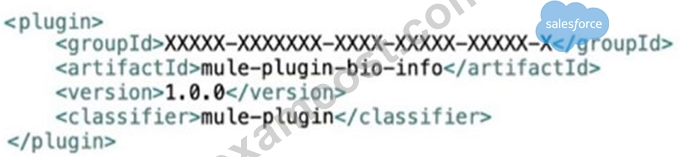
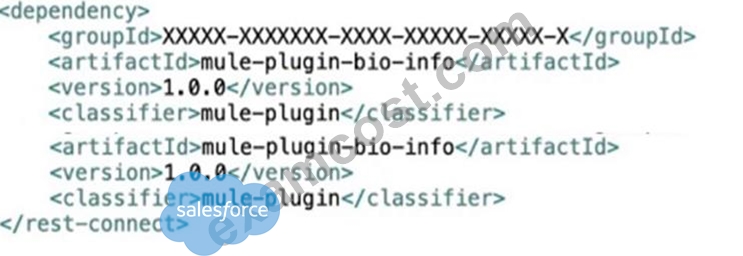
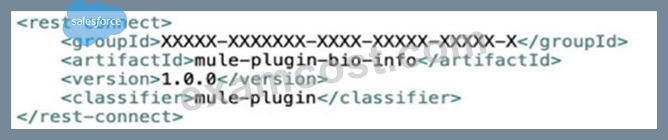
Refer to the exhibits.
Bioinfo System API is implemented and published to Anypoint Exchange. A developer wants to invoke this API using its REST Connector.
What should be added to the POM?
- A.
- B.
- C.

- D.

- E.
Answer: A
Explanation:
To invoke Bioinfo System API using its REST Connector, option E should be added to the pom.xml file. This option adds a dependency for Bioinfo System API REST Connector with its group ID, artifact ID, version, classifier, and type. The classifier specifies that it is a REST Connector (raml-client), and the type specifies that it is a Mule plugin (mule-plugin). Reference: https://docs.mulesoft.com/apikit/4.x/apikit-4-generate-from-rest-api-task#add-the-api-dependency-to-the-pom-file
NEW QUESTION # 24
A developer is working on a project that requires encrypting all data before sending it to a backend application. To accomplish this, the developer will use PGP encryption in the Mule 4 Cryptography module.
What is required to encrypt the data before sending it to the backend application?
- A. The application needs to configure HTTPS TLS context information to encrypt the data
- B. The application needs the public key from the backend service to encrypt the data
- C. The application needs to both the private and public keys to encrypt the data
- D. The application needs the private key from the backend service to encrypt the data
Answer: B
Explanation:
To encrypt the data before sending it to the backend application using PGP encryption, the application needs the public key from the backend service. PGP encryption uses a public-key cryptography system, which means that each party has a pair of keys: a public key and a private key. The public key is used to encrypt data, and the private key is used to decrypt data. Therefore, to encrypt data for a specific recipient (the backend service), the application needs to use the recipient's public key. The recipient can then use its own private key to decrypt the data. Reference: https://docs.mulesoft.com/mule-runtime/4.3/cryptography-pgp
NEW QUESTION # 25
A mule application exposes and API for creating payments. An Operations team wants to ensure that the Payment API is up and running at all times in production.
Which approach should be used to test that the payment API is working in production?
- A. Configure the application to send health data to an external system
- B. Create a health check endpoint that listens on a separate port and uses a separate HTTP Listener configuration from the API
- C. Create a health check endpoint that reuses the same port number and HTTP Listener configuration as the API itself
- D. Monitor the Payment API directly sending real customer payment data
Answer: B
NEW QUESTION # 26
A healthcare portal needs to validate the token that it sends to a Mule API. The developer plans to implement a custom policy using the HTTP Policy Transform Extension to match the token received in the header from the heathcare portal.
Which files does the developer need to create in order to package the custom policy?
- A. XML template file, YAML configuration file
- B. JSON properties file, YAML configuration file
- C. Deployable ZIP file, YAML configuration file
- D. JSON properties file, XML template file
Answer: A
Explanation:
To package a custom policy using the HTTP Policy Transform Extension, the developer needs to create an XML template file and a YAML configuration file. The XML template file defines the policy logic using Mule components and placeholders for user-defined properties. The YAML configuration file defines the metadata of the policy, such as its name, description, category, parameters, and dependencies. Reference: https://docs.mulesoft.com/api-manager/2.x/http-policy-transform#packaging-the-policy
NEW QUESTION # 27
A new Mule project has been created in Anypoint Studio with the default settings.
Which file inside the Mule project must be modified before using Maven to successfully deploy the application?
- A. Mule.artificact.json
- B. Pom.xml
- C. Settings.xml
- D. Config.yaml
Answer: B
Explanation:
To use Maven to successfully deploy the application, the developer needs to modify the pom.xml file inside the Mule project. The pom.xml file contains the configuration and dependencies of the Mule application, as well as the deployment information such as the CloudHub region, environment, and worker size. The developer needs to specify these properties in the pom.xml file before using Maven to deploy the application. Reference: https://docs.mulesoft.com/mule-runtime/4.3/mmp-concept#application-deployment-descriptor
NEW QUESTION # 28
A Mule application uses API autodiscovery to access and enforce policies for a RESTful implementation.
- A. Northing because flowRef is an optional attribute which can be passed runtime
- B. The name of the flow that has APlkit Console to receive all incoming RESTful operation requests.
- C. The name of the flow that has HTTP listener to receive all incoming RESTful operation requests
- D. Any of the APIkit generate implement flows
Answer: C
Explanation:
To use API autodiscovery to access and enforce policies for a RESTful implementation, flowRef must be set to the name of the flow that has HTTP listener to receive all incoming RESTful operation requests. This way, API autodiscovery can identify the API implementation and associate it with the corresponding API specification and policies in API Manager. The flow that has HTTP listener is usually the main flow that contains the APIKit Router. Reference: https://docs.mulesoft.com/api-manager/2.x/api-auto-discovery-new-concept#flowref
NEW QUESTION # 29
A mule application exposes and API for creating payments. An Operations team wants to ensure that the Payment API is up and running at all times in production.
Which approach should be used to test that the payment API is working in production?
- A. Configure the application to send health data to an external system
- B. Create a health check endpoint that listens on a separate port and uses a separate HTTP Listener configuration from the API
- C. Create a health check endpoint that reuses the same port number and HTTP Listener configuration as the API itself
- D. Monitor the Payment API directly sending real customer payment data
Answer: B
Explanation:
To test that the payment API is working in production, the developer should create a health check endpoint that listens on a separate port and uses a separate HTTP Listener configuration from the API. This way, the developer can isolate the health check endpoint from the API traffic and avoid affecting the performance or availability of the API. The health check endpoint should return a simple response that indicates the status of the API, such as OK or ERROR. Reference: https://docs.mulesoft.com/api-functional-monitoring/afm-create-monitor#create-a-monitor
NEW QUESTION # 30
A Flight Management System publishes gate change notification events whenever a flight's arrival gate changes. Other systems, including Baggage Handler System. Inflight Catering System and Passenger Notifications System, must each asynchronously receive the same gate change notification to process the event according.
Which configuration is required in Anypoint MQ to achieve this publish/subscribe model?
- A. Publish the gate change notification to an Anypoint MC queue
Have each client subscribe directly to the queue - B. Publish each client subscribe directly to the exchange.
Have each client subscribe directly to the queue. - C. Publish the gate change notification to an Anypoint MQ queue.
Create different anypoint MQ exchange meant for each of the other subscribing systems Bind the queue with each of the exchanges - D. Publish the gate change notification to an Anypoint MQ exchanhe.
Create different Anypoint MQ queues meant for each of the other subscribing systems.Bind the exchange with each of the queues.
Answer: D
Explanation:
To achieve a publish/subscribe model using Anypoint MQ, where each system receives the same gate change notification event, the developer should publish the gate change notification to an Anypoint MQ exchange, create different Anypoint MQ queues meant for each of the other subscribing systems, and bind the exchange with each of the queues. An exchange is a message routing agent that can send messages to different queues based on predefined criteria. By binding an exchange with multiple queues, each queue receives a copy of every message sent to that exchange. Therefore, each system can subscribe to its own queue and receive every gate change notification event. Reference: https://docs.mulesoft.com/anypoint-mq/3.x/anypoint-mq-exchanges
NEW QUESTION # 31
Which pattern should be used to invoke multiple HTTP APIs in parallel and roll back failed requests in sequence?
- A. VM queues as a reliability pattern with error handlers to roll back any requests
- B. Scatter-Gather as central Saga orchestrator for all API request with compensating actions for failing routes
- C. A Parallel for Each scope with each HTTP request wrapped in a Try scope
- D. A database as a transactional outbox and an Until Successful router to retry any requests
Answer: B
Explanation:
To invoke multiple HTTP APIs in parallel and roll back failed requests in sequence, the developer should use a Scatter-Gather router as a central Saga orchestrator for all API requests with compensating actions for failing routes. A Scatter-Gather router executes multiple routes concurrently and aggregates the results. A Saga orchestrator coordinates a series of actions across different services and handles failures by executing compensating actions. Therefore, using a Scatter-Gather router as a Saga orchestrator allows invoking multiple HTTP APIs in parallel and rolling back any failed requests in sequence. Reference: https://docs.mulesoft.com/mule-runtime/4.3/scatter-gather-concept https://docs.mulesoft.com/mule-runtime/4.3/saga
NEW QUESTION # 32
A Mule application deployed to multiple Cloudhub 2.0 replicas needs to temporarily persist large files over 10MB between flow executions, and routinely needs to query whether the file data exists on separate executions.
How can this be achieved?
- A. Store the contents of the file on separate storage, and store the key and location of the file Object using Object Store v2
- B. Use an in-memory Object Store
- C. Store the key and full contents of the file in an Object Store
- D. Store the key and full contents of the file, caching the filename and location between requests
Answer: A
Explanation:
To temporarily persist large files over 10MB between flow executions, and routinely query whether the file data exists on separate executions, the developer should store the contents of the file on separate storage, and store the key and location of the file object using Object Store v2. This way, the developer can avoid storing large files in memory or exceeding the size limit of Object Store v2 (10MB per object). The developer can also use Object Store v2 operations to query, retrieve, or delete the file object by its key. Reference: https://docs.mulesoft.com/object-store/osv2-faq#can-i-store-files-in-object-store-v2
NEW QUESTION # 33
A developer has created the first version of an API designed for business partners to work commodity prices.
What should developer do to allow more than one major version of the same API to be exposed by the implementation?
- A. In Anypoint Studio, generate scaffolding from the RAML, and the modify the <http:listerner> in the generated flows to include a parameter to replace the version number
- B. In Design Center, open the RAML and modify baseUn to include a variable that indicates the version number
- C. In Design Center, open the RAML and modify each operation to include the major version number
- D. In Anypoint Studio, generate scaffolding from the RAML, and then modify the flow names generated by APIKit to include a variable with the major version number
Answer: B
Explanation:
To allow more than one major version of the same API to be exposed by the implementation, the developer should modify the baseUri property in the RAML file to include a variable that indicates the version number. The baseUri property defines the base URL of the API and can include variables that are replaced with actual values when mocking or deploying the API. By using a variable for the version number, the developer can expose different versions of the API using different base URLs and avoid conflicts or confusion. Reference: https://docs.mulesoft.com/api-designer/design-modify-raml-specs#baseuri https://docs.mulesoft.com/api-manager/2.x/api-versioning
NEW QUESTION # 34
Refer to the exhibit.
What is the result if ''Insecure'' selected as part of the HTTP Listener configuration?
- A. The HTTP Listener will trust any certificate presented by the HTTP client
- B. The HTTP listener will only accept HTTP requests
- C. Mutual TLS authentication will be enabled between this HTTP Listener and an HTTP client
- D. The HTTP Lister will accept any unauthenticated request
Answer: B
Explanation:
Based on the exhibit below, if 'Insecure' is selected as part of the HTTP Listener configuration, the HTTP listener will only accept HTTP requests. This means that no TLS context will be configured for this listener and no encryption or authentication will be applied to incoming requests. The protocol attribute of this listener will be set to HTTP instead of HTTPS. Reference: https://docs.mulesoft.com/http-connector/1.6/http-listener-ref#insecure
NEW QUESTION # 35
The Center for Enablement team published a common application as a reusable module to the central Nexus repository.
How can the common application be included in all API implementations?
- A. Copy the common application's source XML file and out it in a new flow file in the src/main/mule folder
- B. Download the common application from Naxus and copy it to the src/main/resources folder in the API
- C. Add a Maven dependency in the POM file with jar as <classifier>
- D. Add a Maven dependency in the PCM file with multiple-plugin as <classifier>
Answer: C
Explanation:
To include a common application as a reusable module in all API implementations, the developer should add a Maven dependency in the POM file with jar as <classifier>. This way, the developer can reuse Mule code from another application by packaging it as a JAR file and adding it as a dependency in the POM file of the API implementation. The classifier element specifies that it is a JAR file. Reference: https://docs.mulesoft.com/mule-runtime/4.3/mmp-concept#add-a-maven-dependency-to-the-pom-file
NEW QUESTION # 36
Refer to the exhibit.
What action must be performed to log all the errors raised by the VM Connector?
- A. Add <AsyncLOgger name='orgroute.extensions vm' level=ERROR'/> inside the Appenders tag
- B. Add <AsyncLOgger name='orgroute.extensions vm' level=ERROR'I> inside the Logger tag
- C. Nothing, as error-level events are automatically logged
- D. Configure <Logger level-'ERROR'/> inside the VM Connector configuration
Answer: A
Explanation:
To log all the errors raised by the VM Connector, the developer needs to add an async logger with the name 'org.mule.extension.vm' and the level 'ERROR' inside the appenders tag of the log4j2.xml file. This will enable logging all error-level events generated by the VM Connector to the console appender. Reference: https://docs.mulesoft.com/mule-runtime/4.3/logging-in-mule#configuring-custom-logging-settings
NEW QUESTION # 37
An API has been developed and deployed to CloudHub Among the policies applied to this API is an allowlist of IP addresses. A developer wants to run a test in Anypoint Studio and does not want any policies applied because their workstation is not included in the allowlist.
What must the developer do in order to run this test locally without the policies applied?
- A. Create a properties file specifically for local development and set the API instance ID to a value that is not used in API Manager
- B. Pass in the runtime parameter ''-Danpow.platform.gatekeeper=disabled''
- C. Run the test as-s, with no changes because the Studio runtime will not attempt to connect to API Manager
- D. Deactivate the API in API Manager so the Autodiscovery element will not find the application when it runs in Studio
Answer: B
Explanation:
To run a test locally without the policies applied, the developer should create a properties file specifically for local development and set the API instance ID to a value that is not used in API Manager. This way, the developer can use different configuration properties for different environments and avoid triggering API autodiscovery when running tests locally. API autodiscovery is a mechanism that associates an API implementation with its corresponding API specification and policies in API Manager based on its API instance ID. By setting this ID to a value that does not exist in API Manager, the developer can prevent API autodiscovery from finding and applying any policies to the local test. Reference: https://docs.mulesoft.com/api-manager/2.x/api-auto-discovery-new-concept#configuring-api-autodiscovery https://docs.mulesoft.com/mule-runtime/4.3/configuring-properties
NEW QUESTION # 38
Which statement is true when using XML SDK for creating custom message processors?
- A. Properties are fields defined by an end user of the XML SDK component and serve as a global configuration for the entire Mule project in which they are used
- B. All operations are public
- C. An XML SDK provides both inbound and outbound operations
- D. Operations can be reused in recursive calls
Answer: A
Explanation:
When using XML SDK for creating custom message processors, all operations are public by default and can be used by any Mule application that imports them. There is no way to make an operation private or protected in XML SDK. Reference: https://docs.mulesoft.com/mule-sdk/1.1/xml-sdk#operations
NEW QUESTION # 39
A Mule implementation uses a HTTP Request within an Unit Successful scope to connect to an API.
How should a permanent error response like HTTP:UNAUTHORIZED be handle inside Until Successful to reduce latency?
- A. In Until Successful configuration, set the retry count to 1 for error type HTTP: UNAUTHORIZED.
- B. Configure retrying until a MULERETRY_EXHAUSTED error is raised or the API responds back with a successful response.
- C. Put the HTTP Request inside a try scope in Unit Successful.
In the error handler, use On Error Continue to catch permanent errors like HTTP UNAUTHORIZED. - D. Put the HTTP Request inside a try scope in Unit Successful.
In the error handler, use On Error Propagate to catch permanent errors like HTTP UNAUTHORIZED.
Answer: C
Explanation:
To handle a permanent error response like HTTP:UNAUTHORIZED inside Until Successful, the developer should put the HTTP Request inside a try scope in Unit Successful, and use On Error Continue to catch permanent errors like HTTP UNAUTHORIZED in the error handler. This way, the developer can avoid retrying requests that will always fail due to a permanent error, and reduce latency. On Error Continue allows the flow to continue processing after handling the error. Reference: https://docs.mulesoft.com/mule-runtime/4.3/until-successful-scope https://docs.mulesoft.com/mule-runtime/4.3/on-error-continue-concept
NEW QUESTION # 40
Which configurations are required for HTTP Listener to enable mTLS authentication?
- A. Set an appropriate keystore configuration and use persistent connections for the listener
- B. Set an appropriate reconnection strategy and use persistent connections for the listener
- C. Set an appropriate truststore configuration and reconnection strategy for the listener
- D. Set an appropriate keystore and truststore configuration for the listener
Answer: D
Explanation:
To enable mTLS authentication for HTTP Listener, the developer needs to set an appropriate keystore and truststore configuration for the listener. The keystore contains the certificate and private key of the Mule application that are used to prove its identity to clients. The truststore contains the certificates of trusted clients that are allowed to access the Mule application. Reference: https://docs.mulesoft.com/mule-runtime/4.3/tls-configuration#mutual-authentication
NEW QUESTION # 41
A company deploys 10 public APIs to CloudHub. Each API has its individual health endpoint defined. The platform operation team wants to configure API Functional Monitoring to monitor the health of the APIs periodically while minimizing operational overhead and cost.
How should API Functional Monitoring be configured?
- A. From one public location with all 10 APIs in a single schedule
- B. From 10 public locations with each API in its own schedule
- C. From one public location with each API in its own schedule
- D. From one private location with all 10 APIs in a single schedule
Answer: A
Explanation:
To configure API Functional Monitoring to monitor the health of 10 public APIs periodically while minimizing operational overhead and cost, the developer should use one public location with all 10 APIs in a single schedule. A public location is a worker that runs in a CloudHub shared environment, which is cheaper and easier to maintain than a private location. A single schedule allows running all 10 APIs tests at the same time and frequency, which reduces complexity and resource consumption. Reference: https://docs.mulesoft.com/functional-monitoring/fm-create-monitor#create-a-monitor
NEW QUESTION # 42
Refer to the exhibit.
A developer generates the base scaffolding for an API in Anypoint Studio.
Which HTTP status code is returned while testing using the API Kit console if no values are entered in client-secret?
- A. HTTP status code:400
- B. HTTP status code:500
- C. HTTP status code:200
- D. HTTP status code:403
Answer: D
Explanation:
Based on the code snippet and schema.json file below, when testing using the API Kit console if no values are entered in client-secret, HTTP status code 403 (FORBIDDEN) is returned. This is because client-secret is defined as a required header parameter in schema.json file, which means that it must be present in every request. If no values are entered in client-secret, then it is equivalent to omitting this header parameter, which violates the schema and causes APIKit Router to return HTTP status code 403. Reference: https://docs.mulesoft.com/apikit/4.x/apikit-4-headers
NEW QUESTION # 43
......
Valid Salesforce-MuleSoft-Developer-II Dumps for Helping Passing Salesforce Exam: https://pass4sure.examcost.com/Salesforce-MuleSoft-Developer-II-practice-exam.html
