

Get Prepared for Your 1Z0-149 Exam With Actual 67 Questions
Valid 1Z0-149 Test Answers Full-length Practice Certification Exams
A quick overview of the Oracle 1Z0-149 Certification Exam:
The Oracle Database Program with PL/SQL is simply called the 1Z0-149 Certification Exam. This exam is authorized by the Oracle Corporation as a credential for Database Programming Specialist certification. The 1Z0-149 Exam is the second level of the Oracle Database Program with PL/SQL certification, which is a part of the Oracle Database Development certifications. The exam focuses on the practical use of PL/SQL, Oracle Database features, and other DBMS features. Therefore, the certification covers the basic concept of the Oracle Database, as well as the most commonly used features. 1Z0-149 exam dumps will help you to cover all the basics of the exam. The certification is recognized by many employers worldwide, Oracle Corporation and other big companies, as well as the US government, and thus this certification is very important to a programmer who is finding a job in the IT industry. If you are an expert, and you want to work in the Oracle Database, then this is the certification that will make sure that your skills are up-to-date, and you can meet all the needs of the job.
Earning the Oracle PL/SQL Developer Certified Professional certification can enhance career opportunities and increase earning potential for professionals in the database development field. It demonstrates a high level of proficiency in PL/SQL programming and validates the ability to design and implement complex database solutions using Oracle technologies.
NEW QUESTION # 36
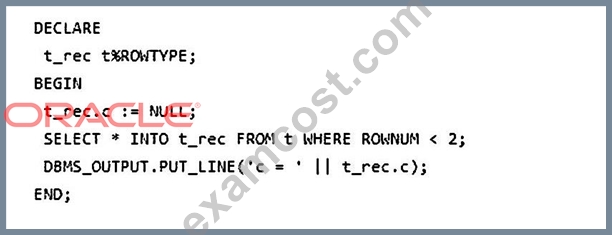
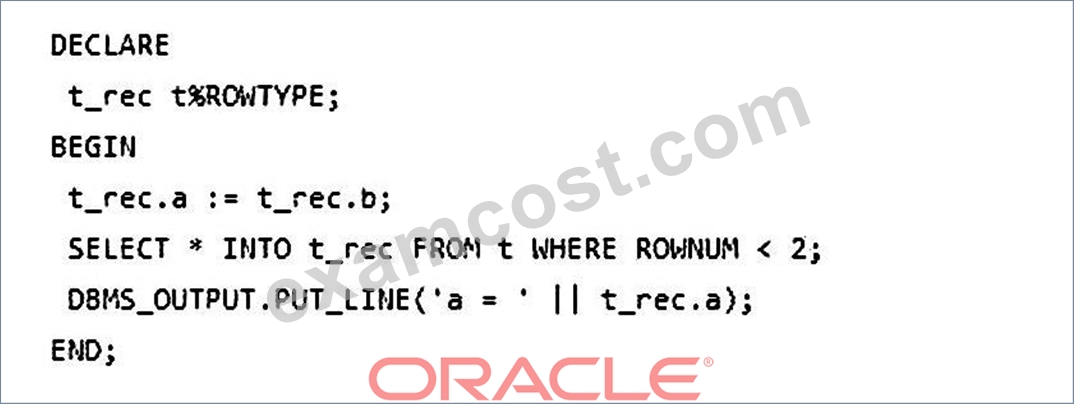
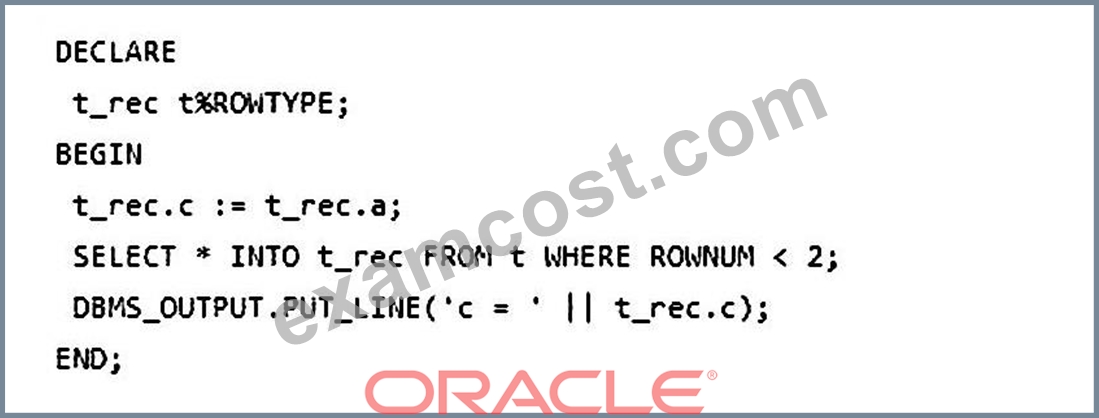
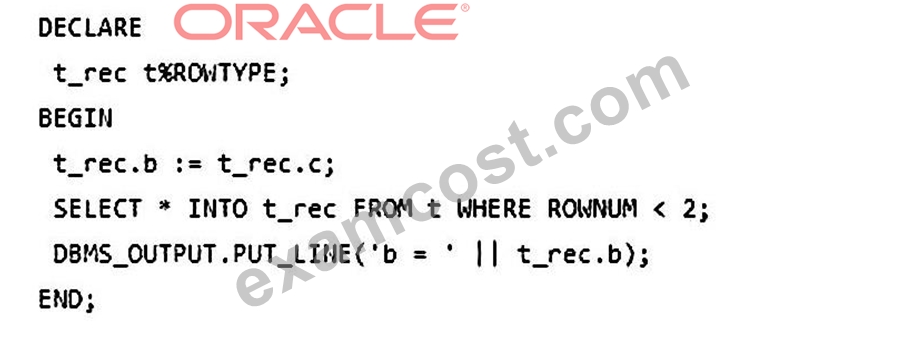
Examine these statements which execute successfully:
Which anonymous block executes successfully?
- A.
- B.
- C.
- D.
Answer: B
NEW QUESTION # 37
Which three are true about the procedure overloading feature? (Choose three.)
- A. Each procedure must use named notation to specify the corresponding actual parameters.
- B. Each procedure can be a nested subprogram.
- C. Each procedure's formal parameters can differ in data type or name.
- D. Each procedure can be a standalone subprogram.
- E. Each procedure can be a packaged subprogram.
- F. Each procedure must use positional notation to specify the corresponding actual parameters.
- G. Each procedure's formal parameters must differ in name.
Answer: C,E,F
NEW QUESTION # 38
SERVEROUTPUT is enabled.
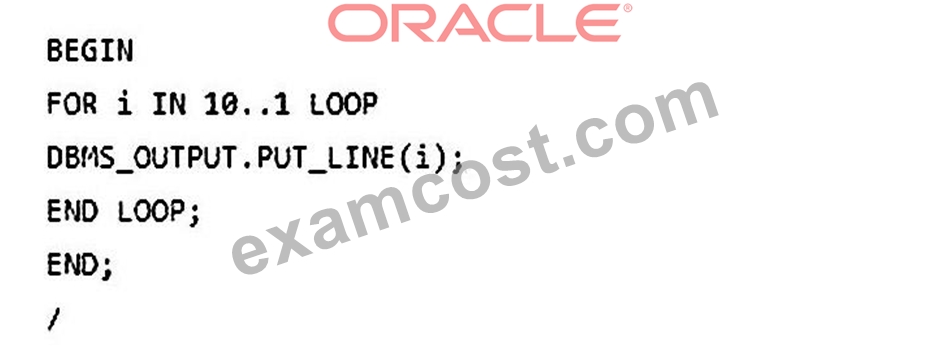
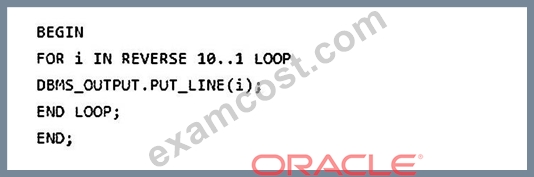
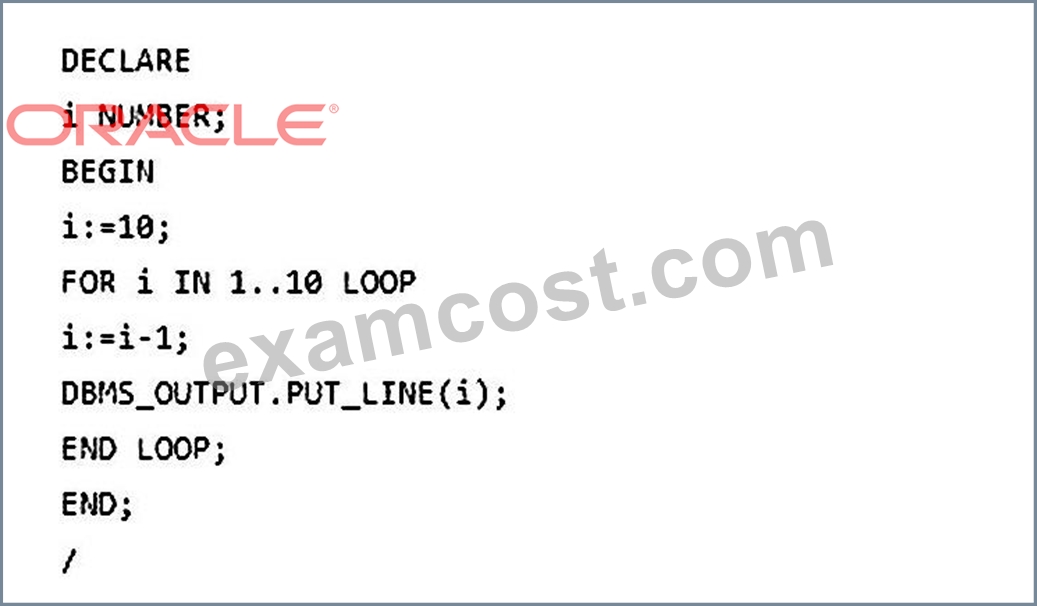
Which code block will display the values from 1 to 10 in descending order?
- A.

- B.
- C.
- D.
Answer: A
NEW QUESTION # 39
Which statement is true about user-defined records?
- A. They can be returned from a function.
- B. The number of fields must match the number of columns in a table.
- C. Field types must match column types.
- D. Field names must match selected column names.
Answer: B
NEW QUESTION # 40
Examine this code:
What will be the outcome?
- A. It will result in an error as the range of the error code can only be from "-20000 to -20999."
- B. It will execute successfully and will display the user-defined error message.
- C. It will result in an error as the range of the error code can only be from "-2000 to -2999."
- D. It will result in an error as the range of the error code can only be from "-1000 to -2000."
Answer: A
NEW QUESTION # 41
Examine this table in the SH schema: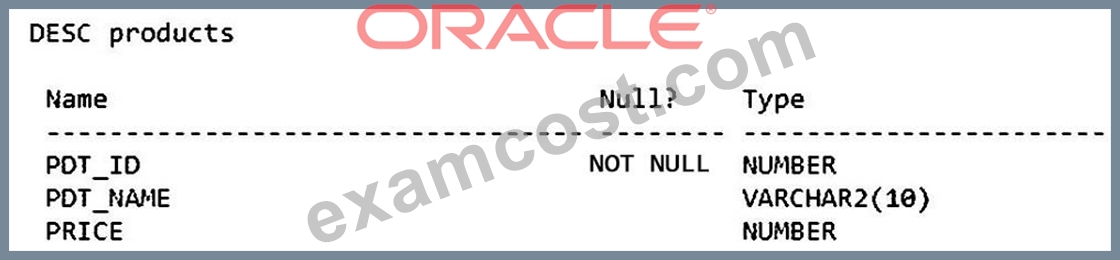
User SH executes this code: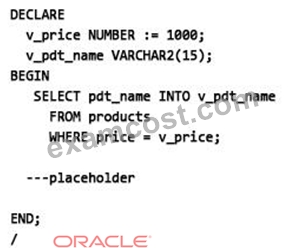
The program must terminate with a user-defined message and no rows displayed if more than one product's price is 1000.
With which option must "---placeholder" be replaced?
- A.

- B.

- C.

- D.

- E.

Answer: E
NEW QUESTION # 42
Which three PL/SQL-only data types can be used in queries and native dynamic SQL issued from PL/SQL in the server? (Choose three.)
- A. a predefined PL/SQL-only data type like BOOLEAN
- B. a record declared in a procedure
- C. a record declared in an anonymous block
- D. an associative array indexed by PLS_INTEGER
- E. an associative array indexed by VARCHAR2
- F. a record declared in a package specification
Answer: D,E,F
NEW QUESTION # 43
Which two blocks of code display a numerical zero? (Choose two.)
- A.

- B.

- C.
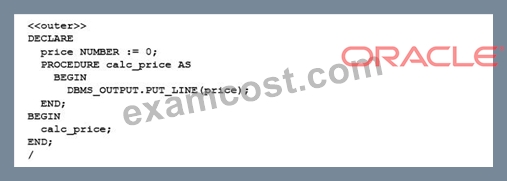
- D.

Answer: B,C
NEW QUESTION # 44
Which three statements are true about Implicit Cursor and Explicit Cursor? (Choose three.)
- A. %Isopen, %Rowtype, %Notfound, and %Found are the attributes of Explicit Cursor.
- B. %Isopen, %Type, %Notfound, and %Found are the attributes of Explicit Cursor.
- C. %Isopen is always false in Explicit Cursor.
- D. %Isopen is always false in Implicit Cursor.
- E. Implicit cursor returns only one record.
- F. %Isopen, %Rowcount, %Notfound, and %Found are the attributes of Explicit Cursor.
- G. Explicit cursor can return more than one record.
Answer: A,D,G
NEW QUESTION # 45
Which two are true about lexical units? (Choose two.)
- A. A character literal with zero characters has the BOOLEAN value NULL.
- B. All user-defined identifiers must start with an alphabet.
- C. Identifiers include labels.
- D. Character literals are case-sensitive.
- E. Spaces can be embedded in delimiters.
Answer: B,D
NEW QUESTION # 46
Which block of code displays the error message "Incorrect price value"?
- A.
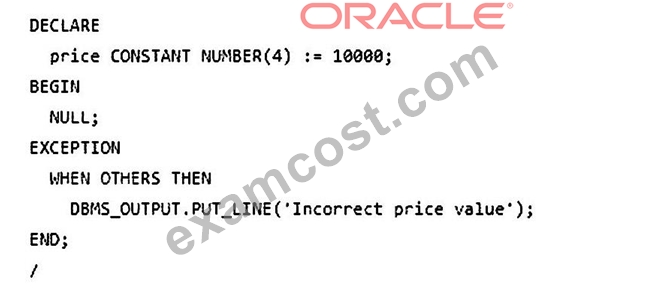
- B.
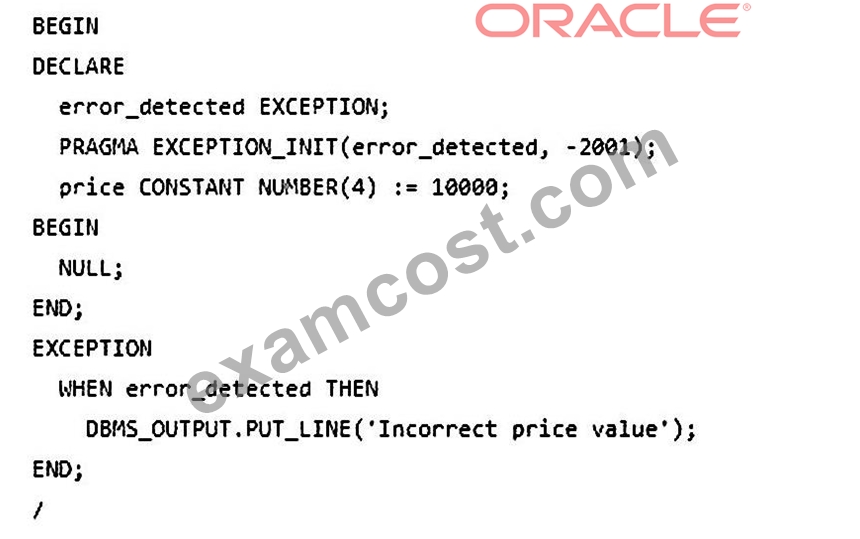
- C.
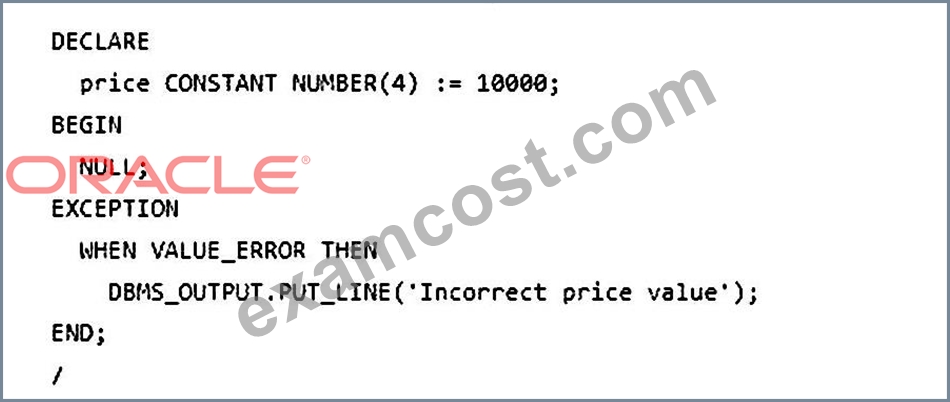
- D.
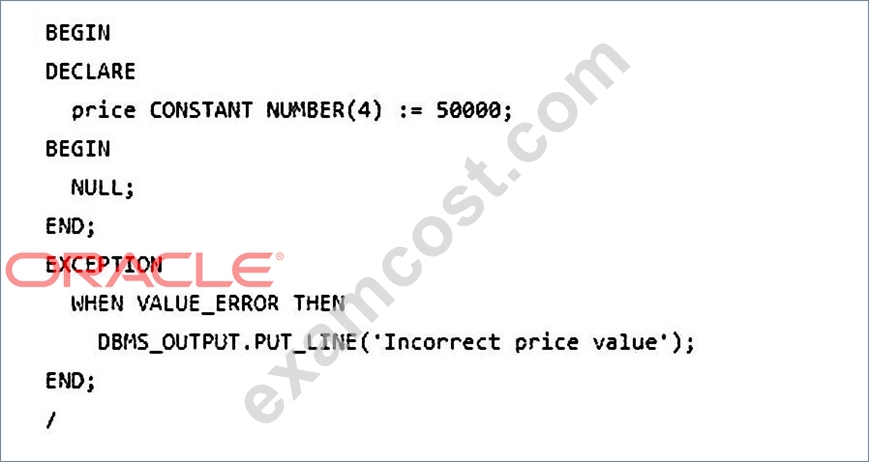
Answer: D
NEW QUESTION # 47
Which two are true about named notations in a PL/SQL subprogram? (Choose two.)
- A. Specifying actual parameters in the wrong order results in the subprogram terminating with an exception.
- B. The subprogram invocations must be changed when the formal parameter list acquires new required parameters.
- C. Only trailing optional parameters can be omitted in the invocation call.
- D. The actual parameters must be specified in the same order as the formal parameters are declared.
- E. Any optional parameters can be omitted in the invocation call.
Answer: D,E
NEW QUESTION # 48
Which is true about the PLSCOPE_SETTINGS parameter?
- A. It can be used to control execution of specific portions of the PL/SQL code conditionally.
- B. It can be used to obtain information about all identifiers when compiling a procedure.
- C. It is deprecated in Oracle 12c.
- D. It can be used to control a user's privileges on PL/SQL objects at run time.
Answer: B
NEW QUESTION # 49
Which three statements are true about passing parameters to subprograms? (Choose three.)
- A. PL/SQL assigns values to actual parameters in subprograms with unhandled exceptions.
- B. Actual parameters corresponding to IN OUT formal parameters can be constants or expressions.
- C. IN OUT parameters pass initial values to subprograms and return values updated by subprograms to the caller.
- D. OUT parameters returning values to calling subprograms act like constants in the called subprogram.
- E. IN parameters passed to subprograms act like variables, to which values can be assigned by the subprogram.
- F. The actual parameter must be a variable when calling a subprogram with an OUT parameter.
- G. IN parameters passed to subprograms act like constants, to which values cannot be assigned by the subprogram.
Answer: C,F,G
NEW QUESTION # 50
Which three statements can process a dynamic multi-row query? (Choose three.)
- A. DECLARE
- B. INTO
- C. FETCH
- D. CLOSE
- E. OPEN-FOR
- F. OPEN
- G. WHEN
Answer: C,D,E
NEW QUESTION # 51
Which two are true about using the ACCESSIBLE BY clause? (Choose two.)
- A. The check is enforced by this clause for direct access and access through dynamic SQL.
- B. It must be specified in the heading of a package body.
- C. It can be used in the declaration of object types.
- D. It must be specified in the heading of a package specification.
- E. It can be used for individual procedures and functions declared in a package specification.
Answer: C,E
Explanation:
https://docs.oracle.com/database/122/LNPLS/ACCESSIBLE-BY-clause.htm
NEW QUESTION # 52
Which two are valid MODIFIER values for the PLSQL_WARNINGS parameter? (Choose two.)
- A. ENABLE
- B. DISABLE
- C. SEVERE
- D. ALL
- E. ERROR
Answer: C,D
NEW QUESTION # 53
......
Accurate & Verified 2026 New 1Z0-149 Answers As Experienced in the Actual Test!: https://pass4sure.examcost.com/1Z0-149-practice-exam.html
